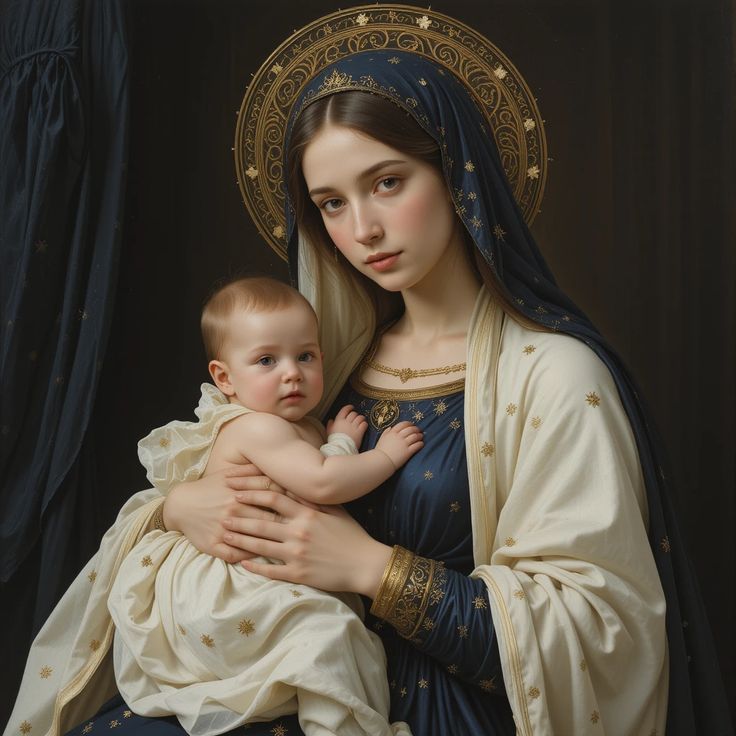
MOTHER OF GOD
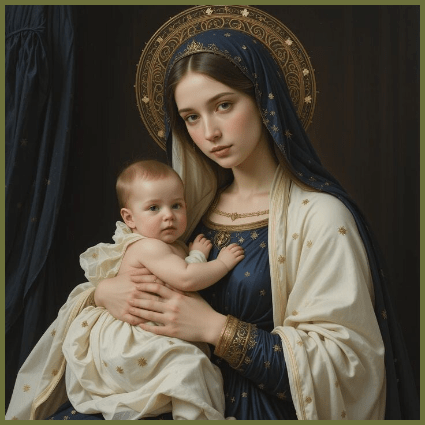
But when the time had fully come, God sent forth his Son,
born of a woman, born under the law,
Galatians 4, 4
Since apostolic time, Catholics have believed and the Church has taught that the Blessed Virgin Mary is truly the Mother of God or, in ancient Greek, Theotokos which means “God-bearer.” This honorable designation means Mary is the mother of the eternal Son of God made man by having conceived and given birth to the Divine Logos in his sacred humanity (Jn 1:1,14). Surely, Mary did not create the divine person of Jesus who existed with the Father for all eternity, but she did provide all the genetic material that was needed to allow God to become a man by the power of the Holy Spirit (Lk 1:35). He is the “seed” or offspring of the woman whom God put in enmity with the serpent (Gen 3:15). Isaiah’s prophecy was fulfilled at the Annunciation once Mary gave her joyful consent in response to the good news that was brought to her by the angel Gabriel: “Behold, the virgin shall conceive, and bear a son whose name shall be Emmanuel” (7:14). The Hebrew name means “God with us” (Mt 1:23).
Mary’s cousin Elizabeth deferentially acknowledged the singular blessing conferred on her kinswoman when she asked her, “Whence is this to me, that the mother of my Lord (Κυρίου/Kyrios) should come to me?” (Lk 1:43). The divine title Adonai ( אֲדֹנָי, lit. “My Lords”) is the plural form of the Hebrew word adon (“Lord”) along with the first-person singular pronoun enclitic. As with Elohim, Adonai’s grammatical form is usually explained as a plural of majesty. In the Hebrew Bible, it is used nearly 450 times to refer to God. The divine name YHWH was increasingly regarded as too sacred to be uttered; it was thus replaced in synagogue ritual with the Hebrew word Adonai (“My Lord”), which was translated as Kyrios (“Lord”) in the Septuagint, the Greek version of the Hebrew Scriptures. Hence, the Blessed Virgin Mary is the mother of our Lord Jesus Christ, who is God Himself in His divine person and as such the Hebrew God of Abraham, Isaac, and Jacob incarnate.
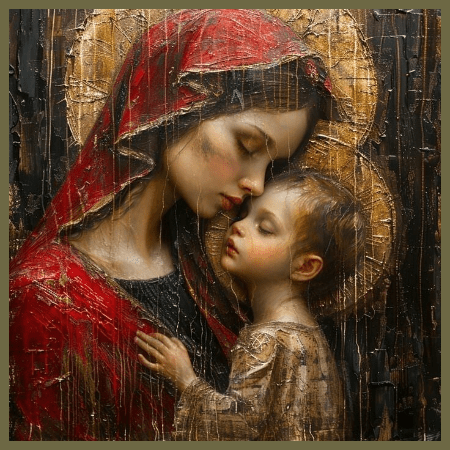
For in him dwelleth all the fulness of the Godhead bodily.
Colossians 2, 9
The phrase “For in him dwelleth all the fullness of the Godhead bodily” from Colossians 2:9 underscores the profound concept of the complete and unabridged presence of divine nature residing in Jesus Christ. This theological assertion asserts that Jesus embodies the entirety of God’s essence—His attributes, authority, and holiness—within His human form. This understanding is crucial for comprehending the dual nature of Christ, who is both fully divine and fully human, a concept foundational to Christian belief.
Furthermore, this doctrine underscores the profound significance of Mary’s role as the mother of Jesus Christ. By giving birth to the Incarnate Word, Mary does not merely witness the unfolding of divine mystery; she actively participates in it, embodying the essential human response to God’s call. Her acceptance of the angelic message— “Behold, I am the handmaid of the Lord; let it be to me according to your word” (Luke 1:38)—demonstrates her unwavering faith and willingness to cooperate with God’s plan of redemption.
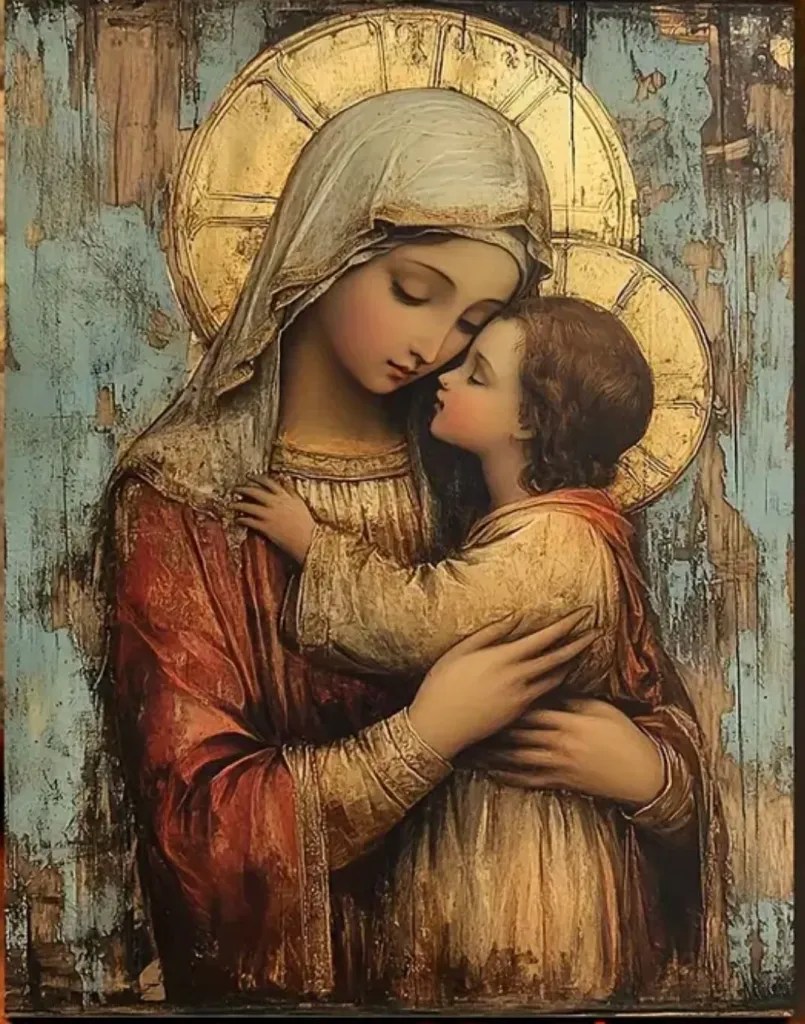
In the context of Mary’s divine maternity, this verse illuminates the profound and unique relationship she shares with the divine. By bearing Jesus, who embodies both full divinity and complete humanity, Mary becomesthe sacred vessel through which the Godhead enters human history in a transformative way. Her role in the Incarnation transcends mere biological function; it is a significant spiritual and theological event central to Christian belief. This act of accepting God’s call not only fulfills ancient prophecies but also signifies the union of heaven and earth, revealing the depth of divine love and God’s accessibility to humanity. Mary’s acceptance, characterized by her ‘fiat’—her willingness to embrace God’s plan—highlights her pivotal position in salvation history. As the Mother of God, she serves as a model of faith and obedience for all believers, reinforcing the importance of her role in the divine narrative.
Additionally, Mary’s motherhood symbolizes a profound and sacred connection to God’s divine essence. As the Theotokos, or “God-bearer,” she occupies a singular and pivotal role within the Christian tradition, highlighting the intricate mystery of the Incarnation—the moment when God became human in the person of Jesus Christ. This concept emphasizes not only her unique status but also the extraordinary nature of her relationship with the divine. The fullness of the Godhead residing in her Son serves as a powerful testament to Jesus’s divine authority and sovereignty, which Mary embodies in her life and actions. Her acceptance of this role reflects deep faith and obedience, exemplifying the virtues of humility and grace. Thus, Mary’s life serves as a living example of how humanity can coexist with and reflect divine purposes, thereby enriching our understanding of both motherhood and divinity within Christian theology.
Ave Maria

 Marian Scripture
Leave a comment