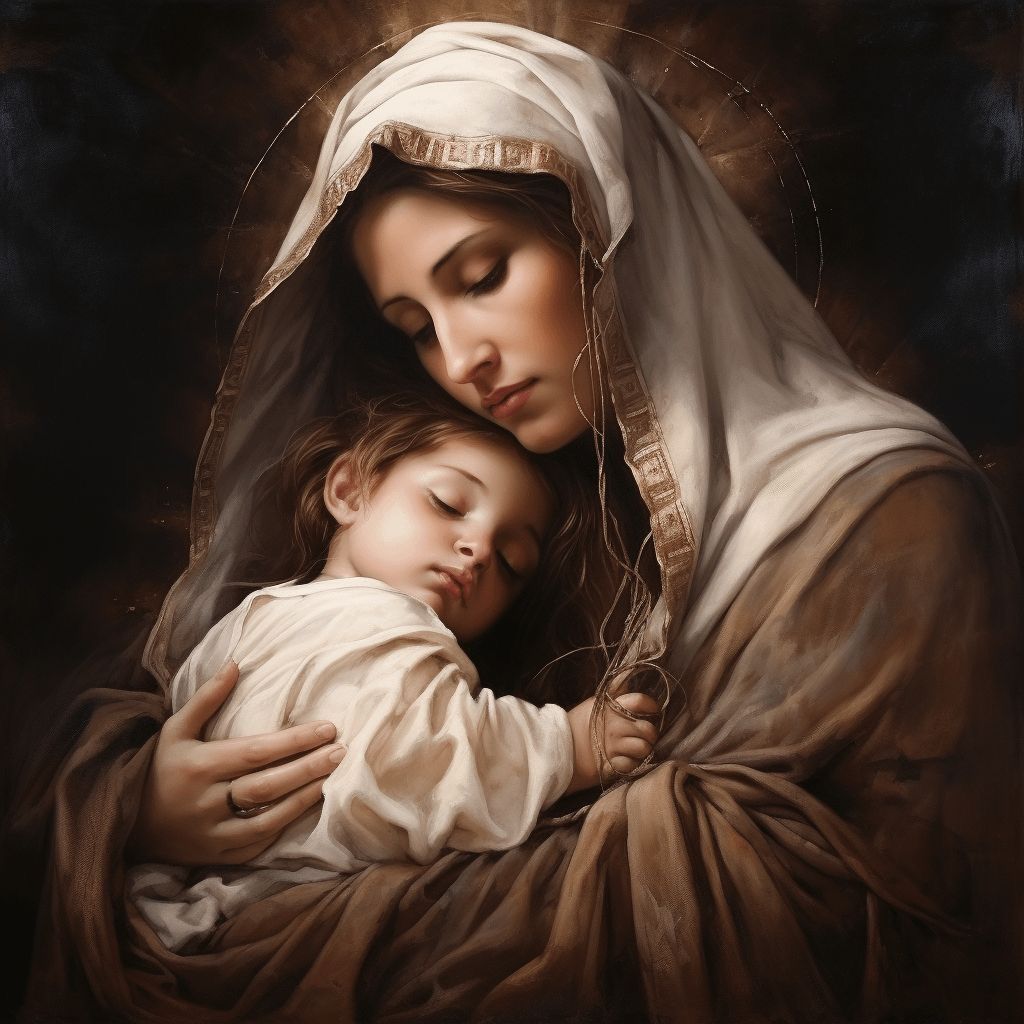
THE IMMACULATE CONCEPTION
And Uzziah said to her, “O daughter, you are blessed by the Most High God above all women on earth; and blessed be the Lord God, who created the heavens and the earth, who has guided you to strike the head of the leader of our enemies.
Judith 13:18
When Elizabeth heard Mary’s greeting,
the infant leaped in her womb,
and Elizabeth, filled with the Holy Spirit,
cried out in a loud voice and said,
“Most blessed are you among women,
and blessed is the fruit of your womb.”
Luke 1, 41-42 [NAB]
In most English versions of the Bible, Elizabeth proclaims, “Blessed are you among women, and blessed is the fruit of your womb.” This phrase is particularly noteworthy when examined in the context of the Catholic New American Bible, which uses the superlative adjective “most” to qualify the feminine past participle “eulogemene,” thereby enriching the statement’s meaning. The expression “blessed among women” can be understood as a Hebraic idiom (Hebraism), implying a deeper sentiment: it literally translates to “most blessed among women” or “blessed above (all) women.” This nuance suggests a distinct elevation of Mary’s status compared to other women, emphasizing her unique role in salvation history as the mother of Jesus.
It is important to note that the New Testament Greek text does not include a superlative form. This absence clarifies why many English translations of the Bible do not include the word “most.” Such differences highlight the interpretive choices translators make, reflecting varying theological perspectives and traditions within Christianity. However, in the rich tapestry of the Old Testament, we encounter two remarkable Jewish heroines, Jael and Judith, who serve as powerful figures within the narrative of salvation history. Their actions reflect their courage and faith and point forward to the New Testament figure of Mary, often recognized as the ultimate expression of feminine faith in the divine plan.

תְּבֹרַךְ֙ מִנָּשִׁ֔ים יָעֵ֕ל אֵ֖שֶׁת חֶ֣בֶר הַקֵּינִ֑י מִנָּשִׁ֥ים בָּאֹ֖הֶל תְּבֹרָֽךְ׃
“Blessed of women shall Jael the wife of Heber the Kenite be,
blessed above women shall she be in the tent.”
–Judges 5, 24
Jael, as recounted in the Book of Judges in the Hebrew Old Testament, emerges as a quintessential example of divine collaboration. In the context of Israel’s struggle against oppression, she plays a crucial role in delivering her people from the tyranny of Sisera, the commander of Jabin’s army. The biblical text exclaims, “Most blessed of women is Jael… blessed among tent-dwelling women” (Judges 5:24). This exaltation highlights her unique status among women. By taking decisive action—hammering a tent peg into Sisera’s temple—she symbolizes the victory of faith and divine justice over evil. Her act of courage not only saves Israel but also demonstrates how God can work through unexpected individuals and means.
Similarly, Judith, another formidable figure, stands as a symbol of strength and divine intervention. Her story unfolds in the Book of Judith, where she confronts the Assyrian general Holofernes. In her encounter, she is blessed as “the daughter…by the Most High God, above all the women on earth” (Judith 13:18). Judith emphasizes the power of faith and cunning in her victory. By decisively guiding her blow at Holofernes’ head, she delivers her people from impending doom, further exemplifying how women in the biblical narrative are instruments of God’s will.
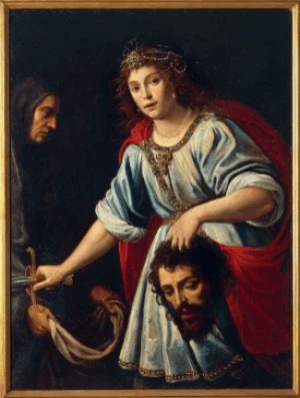
Then Uzziah said to her,
“Blessed are you daughter, by the Most High God, above all the women on earth;
and blessed be the Lord God, the creator of heaven and earth,
who guided your blow at the head of the leader of our enemies.”
Judith 13, 18
καὶ εἶπεν αὐτῇ ᾿Οζίας· εὐλογητὴ σύ, θύγατερ, τῷ Θεῷ τῷ ῾Υψίστῳ παρὰ πάσας τὰς γυναῖκας τὰς
ἐπὶ τῆς γῆς, καὶ εὐλογημένος Κύριος ὁ Θεός, ὃς ἔκτισε τοὺς οὐρανοὺς καὶ τὴν γῆν, ὃς κατεύθυνέ
σε εἰς τραῦμα κεφαλῆς ἄρχοντος ἐχθρῶν ἡμῶν
What is particularly striking about these passages in the Hebrew Bible and the Septuagint is their close parallel with the New Testament Gospel of Luke, which celebrates Mary’s role in salvation history. The recurring themes of blessing and victory, and the imagery of a woman triumphing over a foe, resonate across these texts. In both Judith and Jael, we see prefigurations of Mary, the woman prophesied to bring salvation to the world through her unique collaboration with God. The angel’s words to Mary, “Blessed are you among women,” mirror the language used in the descriptions of Jael and Judith, creating a continuity in understanding God’s work through women across the scriptures. All these elements weave together to form a rich narrative that emphasizes the importance of faith and courage and the pivotal roles that women have played in the unfolding story of God’s redemption throughout biblical history.
Let’s explore the connection between Judith 13:18 and Luke 1:42. The passage from Judith is from the Septuagint, the Greek translation of the Hebrew Old Testament. Similarly, the Gospel of Luke was also written in Greek. This relationship exemplifies St. Augustine’s observation that “The New Testament lies hidden in the Old, and the Old Testament is unveiled in the New,” as stated in his Commentary on the Sermon on the Mount. This insight highlights the intertextual dialogue between the two testaments, revealing the continuity of biblical themes and messages.
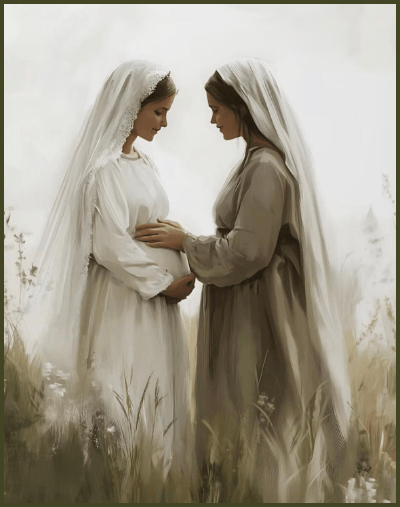
To fully grasp the significance of Luke’s declaration that Mary is blessed, it is essential to delve into the Greek terminology he employs to describe her state of grace. Notably, he uses a word distinct from the one in Luke 1:45, which is “makaria” (μακαρία), commonly translated as “blessed” in a general sense. Instead, St. Luke uses the feminine perfect passive participle “eulogemene” (Εὐλογημένη), a term rooted in the verb “eulogeo” (εὐλογέω), meaning “to bless.”
This participle, “eulogemene,” literally means “having been blessed” and serves as a powerful benediction. Its grammatical structure—the perfect aspect—implies that the action of being blessed has been completed before Elizabeth’s praise towards Mary. While the exact timing of this action remains unspecified, the implication is profound: it suggests that the blessing was conferred long before Mary’s moment of recognition by Elizabeth, likely at the very instant of her immaculate conception. This conception is understood as being in virtue of Mary’s unique election to the Divine Maternity, highlighting her exceptional role in salvation history.
In this context, the use of “eulogemene” emphasizes the completed state of Mary’s grace and her elevated status as a favored recipient of divine grace, underscoring the theological significance of her role as the Mother of God. This nuanced understanding enriches our appreciation of the text and invites deeper reflection on the implications of Mary’s blessedness within the Christian tradition.
The term “blessed” (Εὐλογημένη) appears in the New Testament on only one other occasion, specifically in the context of the Kingdom of Heaven: “Blessed (eulogemene) be the kingdom of our father David that cometh: Hosanna in the highest” (Mark 11:10). The verb eulogemene is derived from the root verb eulogeo (εὐλογέω), which means to speak well of or to bless. In this passage, the evangelist draws a significant parallel between Mary, the mother of Jesus, and the Kingdom of God. This connection highlights the profound nature of Mary’s role in salvation history, suggesting that just as the Kingdom of Heaven is blessed and brings divine favor, so too does Mary, who bears the very Son of God. This dual understanding emphasizes the sacredness and importance of Mary and the Kingdom, inviting believers to recognize the divine grace in both.
Mary’s blessed state encompasses far more than the honor of being chosen by God as the mother of Jesus. While this extraordinary privilege undoubtedly brings her joy, the term Luke uses suggests a deeper significance. He does not employ the word “makaria,” which translates directly to “happy.” Instead, Elizabeth’s words reflect a profound admiration that transcends mere acknowledgment of Mary’s biological role as the mother of her Lord.
Luke also writes: “The kingdom of God is within you” (Lk 17:21). The Greek word for “within” is entos (ἐντός), which can be interpreted as either “inside” (within) or “among.” This term is derived from the preposition en (ἐν), meaning “in.” In the context of St. Luke’s description, wherein he draws a parallel between Mary and the kingdom of God, the former interpretation—“inside”—is particularly relevant. This suggests that the text refers to her profound inner state, which reflects the divine qualities of her Son’s humanity.
This connection becomes even clearer when considering related passages in Scripture. For instance, in 1 Corinthians 3:16, Paul emphasizes the sanctity of believers by stating, “Know you not that you are the temple of God, and that the Spirit of God dwelleth in you?” Here, Paul is reinforcing the idea that God’s presence resides within individuals, much like a temple. Moreover, in John’s Gospel, Jesus says, “Destroy this temple, and in three days I will raise it up” (Jn 2:19). In this context, “temple” refers to His own body, underscoring the notion that true divinity and holiness can dwell within a physical form. Together, these passages illuminate the profound significance of Mary’s role within the kingdom of God, highlighting her unique inner disposition as one who embodies and reflects the divine presence.
In her fervent proclamation, Elizabeth proclaims her kinswoman Mary profoundly blessed because of her soul’s extraordinary purity and sanctity. This reflection of divine grace mirrors the justice and holiness embodied in her Son, Jesus Christ. As the Mother of our Lord, Mary is uniquely favored for her pivotal role in giving birth to the long-awaited Messiah and for the singular grace of the Holy Spirit dwelling within her. This divine presence has endowed her with the sanctifying and justifying grace essential for her purity, elevating her to a state of immaculate grace akin to that of her divine Son in His sacred humanity. This profound truth is beautifully underscored in scripture, particularly in 1 John 3:3, which emphasizes that all who have this hope in Christ seek to purify themselves just as He is pure, further highlighting Mary’s unparalleled example of holiness and devotion.
The Greek root verb eulogeo, which means “to bless,” appears seven times in the Gospels, specifically in the masculine perfect passive participle form, and is unique to Jesus Christ. One notable occurrence is in the second clause of Luke 1:42, where it parallels references in the Book of Judith to YHWH, thereby emphasizing a divine blessing. Another significant instance can be found in Mark 11:9, where the multitudes proclaim: “And those who went before and those who followed cried out, saying: Hosanna! Blessed (eulogemenos / εὐλογημένος) is he who comes in the name of the Lord.” This phrase highlights the recognition of Jesus’ divine authority and messianic role as the one sent by God, inviting deeper reflection on the blessed state of the Kingdom of Heaven. The Kingdom, under the divine rule, mirrors the blessed state of the Lord himself, who is described as “full of grace and truth” in John 1:14. This description underscores the unique nature of Jesus’ humanity, which is entirely infused with sanctifying grace.
Additionally, this theme resonates with the narrative surrounding His blessed mother, Mary, who is portrayed as the epitome of grace and favor. In Luke 1:28 (DRB), the angel visits her, declaring, “Hail, full of grace (Ave gratia plena), the Lord is with thee: blessed art thou among women.” The original Greek text uses the term kecharitomene, which translates to “completely and perfectly graced in the past with a permanent result.” This profound declaration reflects not only a moment in time but also an enduring state of sanctifying or justifying grace bestowed upon Mary by virtue of her election to the divine maternity.
Thus, in the Gospel of Luke, both Jesus and Mary are portrayed as uniquely and equally blessed, sharing a profound divine favor that equips them with the spiritual capacity to fulfill a pivotal Divine purpose: the redemption of humanity. This dual blessing signifies their consecration to God, illustrating that they have been set apart to serve Him in a special way. Both figures are sanctified by God’s grace, which makes them holy and allows them to participate fully in His redemptive plan.
Their shared humanity underscores a significant theological perspective by emphasizing that they are both integral to God’s mission of salvation. This mission involves rectifying the consequences of humanity’s fall, as initiated by the serpent in the Garden of Eden (Genesis 3:14). By highlighting the sanctity and divine favor bestowed upon Jesus and Mary, Luke reveals their essential roles in God’s overarching narrative of justice and grace, illustrating how, through them, the divine intention of restoring humanity is realized.
God’s heavenly kingdom finds its fullest expression in Mary, the Mother of Jesus, for in her unique disposition and actions, she embodies and vividly manifests this divine kingdom amidst a fallen and broken humanity. Her presence heralds the coming of the divine Messiah and serves as a channel for the outpouring of His life-giving grace, as prophesied in the Scriptures, including Jeremiah 31:31-34 and Ezekiel 36:24-27. In her profound personal relationship with God, Mary faithfully observes the law of the first covenant established at Sinai, which is now inscribed in her heart. This law transcends merely written commandments on stone; it is the natural law of love and freedom that the Holy Spirit has intimately revealed to her soul.
Mary’s covenant with God represents the new and everlasting covenant, beautifully established through the mediation of her divine Son, Jesus Christ, particularly highlighted in the moment of the Last Supper (Luke 22:20). The precious blood of her Son is not merely a means of cleansing her from sin; rather, it has preserved her from being tainted by it altogether, reflecting the unique grace bestowed upon her by the Savior. This justifying blood, which was mystically mingled with her own in her holy womb at the Incarnation, first applies to her in honor of her unique role in salvation history and for establishing her sacred covenant with God, ensuring her a pivotal place within the divine plan of redemption.
The Virgin Mary is the first human being to experience the profound fruits of redemption in a unique and unparalleled way. Her extraordinary grace stems not only from her status as the Divine Mother of Jesus Christ but also from the remarkable purity of her conscience, which has never faced condemnation throughout her life, including at the time of her Dormition, as highlighted in 1 John 3:20. This unprecedented grace underscores the assertion that there is no necessity for our Blessed Lady to seek repentance; she has faithfully upheld her covenant with God, having never committed any personal sins at any moment in her existence. Her life is a testament to unwavering fidelity and holiness, inspiring all to pursue spiritual integrity.
As an impeccable participant in the divine nature, Mary stands distinguished as free from all corruption that arises from the tumult of human desires—an affliction vividly noted in scripture (2 Peter 1:4). Her uniqueness is rooted in the light of the Holy Spirit, who dwells within her, allowing the essence of divinity to radiate through her very soul. This divine presence is beautifully mirrored in her relationship with her Son, Jesus Christ, whose divine attributes are reflected in her being.
Through her profound love for God and her unyielding charity toward humanity, the extraordinary qualities of her soul become a beacon of divine light, illuminating the world around her. The psalmist eloquently expresses this divine illumination: “Out of Zion, the perfection of beauty, God shines forth” (Psalm 50:2). This declaration heralds the arrival of God’s new kingdom on earth, emphasizing the glory and majesty He seeks to reveal through His creations (Matthew 5:16). At the core of Mary’s existence lies an undefiled essence that perfectly mirrors the inherent righteousness of her divine Son, who embodies humanity’s ideal (1 John 3:3). By consistently cooperating with the graces and gifts bestowed upon her by the Holy Spirit, Mary safeguards her purity. Her choices and actions reflect a steadfast commitment to maintaining the same unblemished purity that defines her divine Son, further solidifying her role as a model of holiness for all.
The glory of God radiates through her soul, prompting her to proclaim His greatness and magnify His name, as expressed in her hymn of praise (Luke 1:46). The kingdom of God, as Jesus teaches, “is neither here nor there” but dwells within Mary, representing a profound union with the divine presence. In this sacred state, she is intimately involved with the Lord in His mission of redemption, standing resolutely in opposition to Satan and the myriad powers of darkness that sow discord and turmoil throughout the world. This fierce opposition unfolds within the framework of God’s divine providence, just as her divine Son fully embodies His sacred humanity, further affirming Mary’s unique role in the divine narrative of salvation.
By describing Mary as “most blessed” (eulogemene), Luke presents her as the quintessential figure of free grace and divine promise, embodying the ideal woman in whom the peace of the Kingdom of God flourishes. This designation highlights Mary’s unique role in salvation history and signifies her profound spiritual status. The quality of her soul reflects the very essence of Heaven, characterized by an absence of any spiritual deficiencies or defects. Our blessed Lady exemplifies perfect freedom from the disordered inclinations that afflict all human beings, inclinations that the faithful must continuously combat in their personal journeys toward unity with God—struggles deeply rooted in the legacy of original sin. Unlike others who navigate the tumult of sin and temptation, Mary embodies an unshakeable joy and tranquility, for she exists in complete harmony with God’s will. Her soul is a sanctuary where peace reigns, shielded from the tumultuous passions and vices that can taint human experience.
The uncontrollable desires that often trouble human nature—such as pride, envy, ambition, greed, and lust—find no place within her. Instead, Mary embodies a range of supernatural virtues that God has bestowed upon her: profound faith, unwavering hope, boundless charity, pure chastity, genuine humility, compassionate kindness, steadfast patience, courageous fortitude, profound wisdom, and gentle kindness. Each of these virtues illuminates her character and serves as an inspiring example for all who seek to follow the path of righteousness and divine grace. The uncontrollable desires that often trouble human nature—such as pride, envy, ambition, greed, and lust—find no place within Mary. Instead, she embodies a remarkable array of supernatural virtues that God has graciously bestowed upon her.
Indeed, the Kingdom of God dwells within Mary, a divine sanctuary where God reigns supreme in her soul, guided by the immaculate presence of the Holy Spirit, her Creator. Her soul is akin to an untouched wilderness, a pure expanse of land that remains unplowed and untainted by the conflicting influences of worldly wisdom and the unnatural desires that often lead humanity astray from the original goodness imbued in creation. Mary is gracefully lifted on the wings of divine grace, a transcendent figure who rises above humanity’s inherently sinful nature (Song of Solomon 2:2).
Mary remains beyond the dragon’s reach and the turbulent waters that represent the chaos of sinfulness (Revelation 12:14). Mary has escaped the chains of original sin, having been conceived without it, thereby embodying the purity and potential of human existence as envisioned by God. Our Blessed Lady is the “free” Woman foretold by the prophets, whose life exemplifies total submission to God’s will. In her, we see the promise fulfilled, for her holy offspring, Jesus Christ, is the free Son of promise, destined to liberate humanity and restore the divine order of creation.
For Mary, there has never been a transition from a state of sin to one of grace, as she stands in unwavering opposition to the serpent, symbolizing evil and temptation. From the very moment of her conception, grace enveloped her, for she was predestined to be the Mother of God, a unique role that set her apart from all humanity. The Blessed Mother of our Lord is not tainted by the inherent human inclination to sin against God; she is a paragon of virtue and holiness. Her unwavering desire to align her will with God’s has always been the cornerstone of her existence. Unlike many who wrestle with dark thoughts and wavering intentions, Mary is free from the inner turmoil that can lead one’s heart astray. The prince of this world, representing sin and temptation, holds no dominion over her soul.
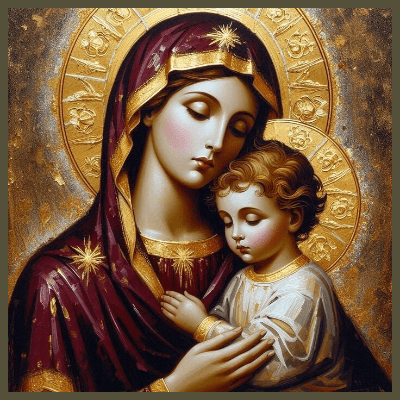
Luke presents the Virgin Mary as a sublime and living symbol of the pneumatic Church, often interpreted as the Kingdom of God on earth. She is depicted as having no “spot or wrinkle,” embodying the characteristics of being “holy and without blemish,” as highlighted in Ephesians 5:27. This portrayal emphasizes her purity and perfection, positioning Mary as a representation of the heavenly Church that reflects the pilgrim Church—composed of believers striving for holiness—here on earth. Mary serves as the ultimate model for all the faithful who have been predestined for divine grace, a foundational concept in theology that underscores the notion of being considered children of God by adoption. This is poignantly expressed in Ephesians 1:3-6, which states that believers are “chosen to be holy and without blemish before Him” in love. This divine selection not only underscores the sanctity attributed to Mary but also illuminates the call to holiness that resonates throughout Christian teachings.
Mary’s blessedness is fundamentally equal to that of her Son, not by nature but through the gift of divine grace. She is uniquely preserved from the stain of original sin by the grace of God, which signifies a special role in salvation history. This preservation means that St. Paul’s exhortation to all the faithful to “put off the old nature for the new nature” (Ephesians 4:22-24) does not apply to her, as she is pure from the moment of her conception. Thus, Mary exemplifies the fulfillment of God’s promise to redeem humanity. She represents God’s re-creation of fallen humanity, signifying a new beginning, initiated as her soul was infused into her body at her conception, setting the stage for her vital role in the Incarnation and the redemptive mission of her Son, Jesus Christ.
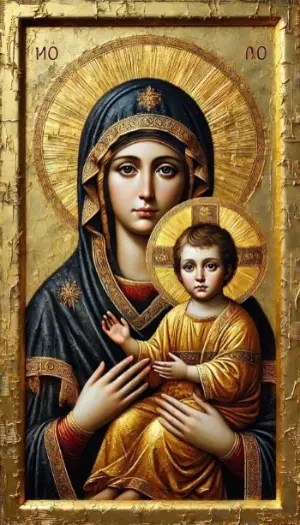
Beautiful for elevation,
the joy of the whole earth,
is Mount Zion,
on the sides of the north,
the city of the great King.
Psalm 48, 2
The Blessed Virgin Mary stands as God’s most extraordinary creation among all humanity, embodying the pinnacle of divine grace. From the moment of her conception, God designed her to be a vessel of holy renewal, intricately crafted to know Him deeply and to exemplify charity, which the Scriptures describe as the bond of perfection (Colossians 3:14). Throughout her life, particularly as she came of age, Mary has consistently sought “the things that are above, where her Son is, seated at the right hand of God” (Col 3:1). Her focus has always been on the eternal and spiritual, as she devoted herself to the divine will. With profound humility and faith, she has “set her mind on things above, not on things that are on earth” (Col 3:2), fully recognizing that her earthly existence is transient. She has embraced a spiritual life, marked by the understanding that she has “died to this world,” allowing her true existence to be “hidden with Christ in God” (Col 3:3).
Every action Mary has undertaken throughout her life—whether in word or deed—has been unwaveringly done “in the name of the Lord” (Colossians 3:17), demonstrating her deep commitment to living a life of holiness. Through the abundant grace lavishly bestowed upon her, the kingdom of God is “neither here nor there,” but dwells “within” Mary in a truly unique and profound way (Luke 17:21). This encapsulation of Mary’s existence offers believers a model of faith, devotion, and the spiritual reality of living in communion with God.
The Protestant theologian Karl Barth rightly stated: “Jesus himself is the kingdom, he was the kingdom, and will be the kingdom, and in him exists the entire establishment, all the salvation, all the joy of the kingdom.” “The identity between Church and kingdom,” Christoph Cardinal Schonborn says, “has its basis in Christ,” yet “there is no higher concretization of this identity for the Church than the Mother of God. It would not be possible to assert this identity if its only basis was Christ, the Head of the Church, and there was no real perfect correspondence on the side of the members of the Church (Mystical Body of Christ) … If Mary did not exist in the Church, then there would be a distance between the Church and the kingdom, because of the presence of sinners in the Church… In Mary, the most perfect member of the Church, we can contemplate the Church’s true nature… ‘As the Mother of Jesus… is the image and the beginning of the Church, which will be perfected in the world to come, so she also shines here on earth in the intermediary time until the day of the Lord comes… as a sign of sure hope and of consolation to the people of God on its pilgrim way’” (Lumen Gentium 58).

Ave Maria
Patristic testimony
St. Hippolytus, Treatise on Christ and anti-Christ, 4 (A.D. 200)
St. Ephraem of Syria Nisibene Hymns 27:8 (A.D. 361)
St. Proclus of Constantinople Homily 1 (ante A.D. 446)
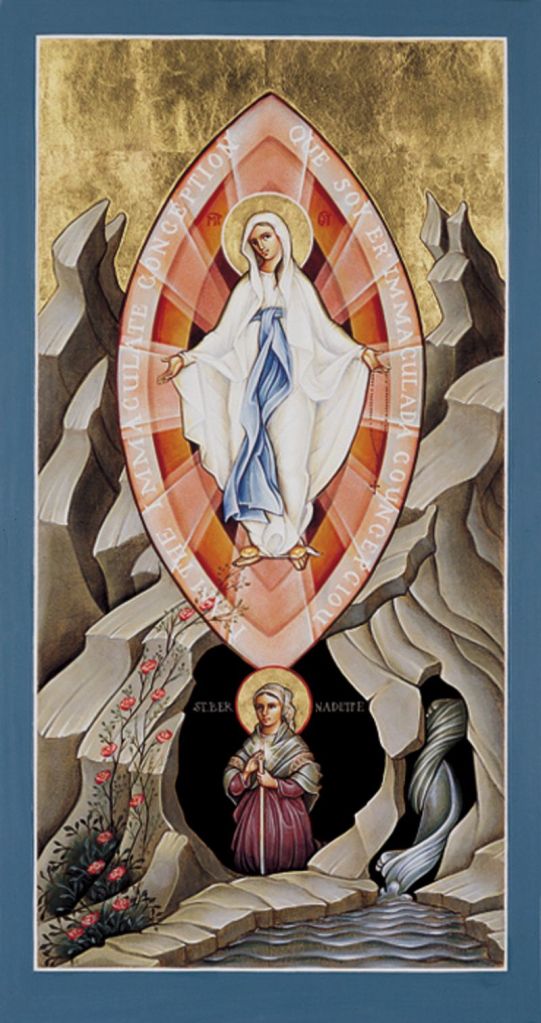
On the Feast of Mary, Our Lady of Lourdes
11 February 2026

 Marian Scripture
Leave a comment