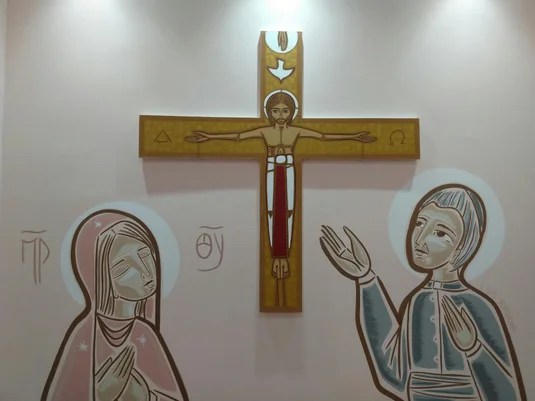
MOTHER OF THE CHURCH
Who has heard of such a thing?
Who has seen such things?
Shall a land be born in one day?
Shall a nation be delivered in one moment?
Yet as soon as Zion was in labor
she delivered her children.
Isaiah 66, 8
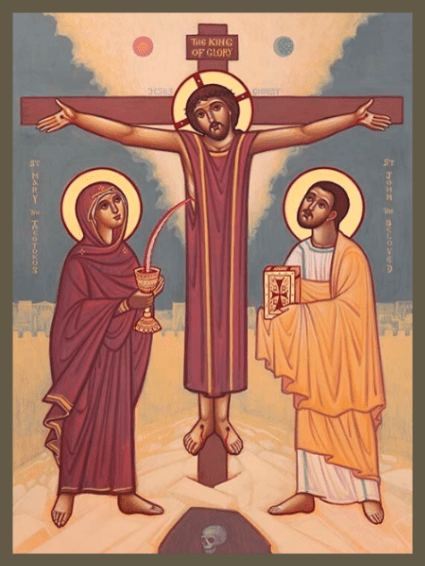
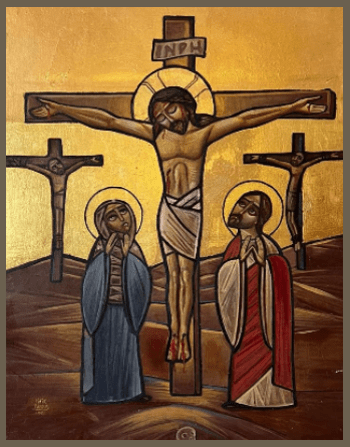
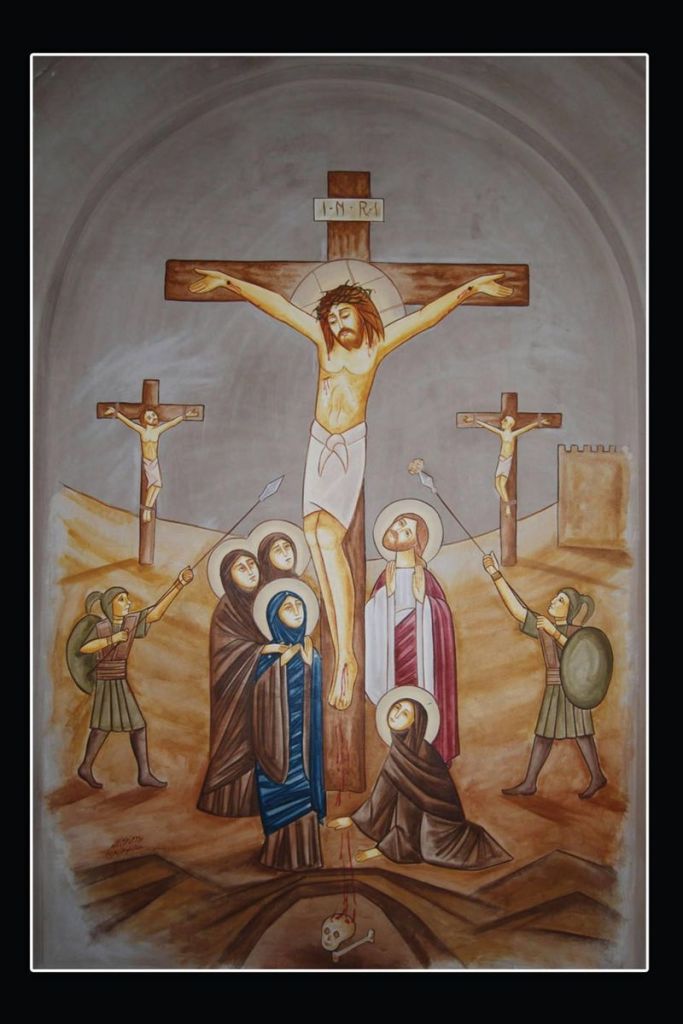
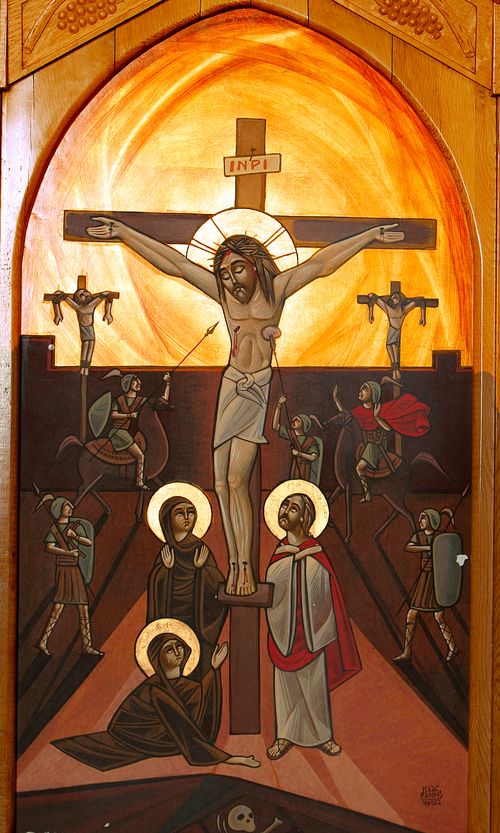
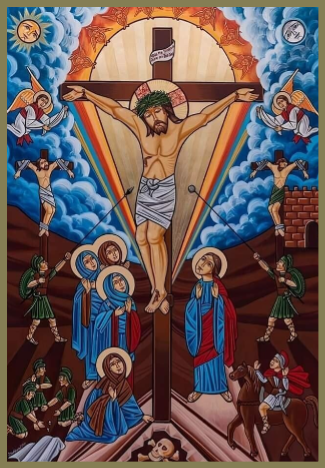
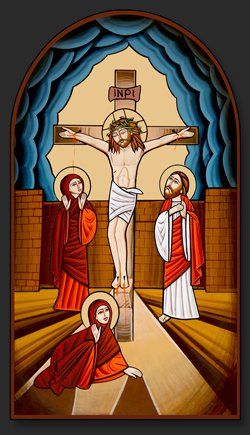
When Jesus therefore had seen his mother and the disciple standing whom he loved,
he saith to his mother: Woman, behold thy son. After that, he saith to the disciple:
Behold thy mother. And from that hour, the disciple took her to his own.
John 19, 26-27 (DRB)
Catholic teaching on Mary, Mother of the Church, emphasizes her pivotal role in the redemption of humanity, particularly through her active participation in the suffering and passion of Jesus Christ. This teaching is deeply rooted in Scripture and Tradition. In particular, Mary’s presence at key moments, such as the Annunciation, where she willingly accepted God’s plan, and her standing at the foot of the cross during the crucifixion, highlights her profound involvement in the salvific work of Christ. Her sorrowful journey is illustrated by Simeon’s prophecy that a sword will pierce her soul (Luke 2:35), underscoring the depth of her suffering as she witnesses her Son’s sacrifice. Mary’s unwavering commitment and deep faith not only illustrate her unique relationship with Christ but also position her as a model for all believers. Through her grace-filled acceptance of her divine mission, Mary exemplifies how human cooperation with the divine will can lead to our redemption. This rich theological understanding of Mary’s experience underscores her vital and intercessory role in the life of the Church and the spiritual journey of all Christians.
This profound truth is powerfully illustrated in her unwavering presence at the foot of the cross during the Crucifixion, where she experienced overwhelming sorrow as she witnessed the agonizing death of her Son. In that harrowing moment, Mary embodies the archetype of suffering, demonstrating empathy and the depths of maternal anguish. Her acceptance of this suffering and her vibrant faith exemplify her commitment to God’s salvific plan for humanity. By enduring this sorrow, Mary not only shares in the Passion of Christ but also aligns her own suffering with his, ultimately cooperating in the divine mystery of redemption and making temporal satisfaction for the world’s sins.
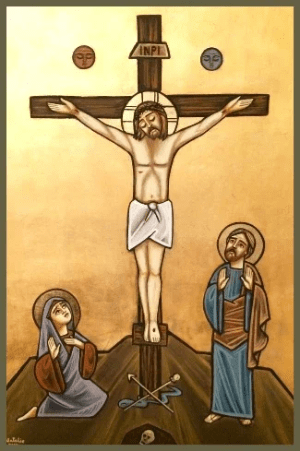
In Catholic theology, while it is firmly established that Jesus Christ is the sole Redeemer of humanity, Mary holds a unique and honored position as co-Redemptrix (“Mother with the Redeemer”). This title reflects her profound cooperation with God’s salvific plan and her active, albeit subordinate, participation in Jesus’s redemptive mission. From the moment of her Annunciation, when she consented to become the Mother of God, Mary exemplified unwavering faith and obedience to God’s will. Her acceptance of this divine vocation brought with it immense suffering, notably as she witnessed the passion and crucifixion of her son, Jesus. The Church teaches that her sorrows and trials represent a deep emotional and spiritual sharing in Christ’s sacrifice, thus allowing her to contribute to the mystery of redemption in a unique way.
In 1964, during the Second Vatican Council, Pope Paul VI officially proclaimed Mary the “Mother of the Church,” a title that underscores her maternal relationship to Jesus Christ and her integral role in the Christian community. This proclamation was not merely ceremonial; it reflected a deeper theological understanding that recognizes the Church as the mystical body of Christ, with Mary as its spiritual mother. * Throughout history, the Virgin Mary has been a symbol of compassion and suffering, and her own trials—such as the anguish she experienced at the crucifixion of her Son—have profoundly connected her to the Church’s suffering throughout the ages. This connection underscores Mary’s empathy and intercessory power, highlighting her importance to believers’ spiritual lives as they navigate their own struggles and challenges within the faith.
Thus, the teaching of Mary, Mother of the Church, reflects the understanding that her participation in the suffering of Christ parallels and complements His redemptive work. Through her sorrows at the foot of the cross, Mary spiritually gave birth to redeemed humanity, thereby demonstrating that, through suffering, one can attain greater intimacy with Christ and a deeper understanding of God’s love. Through Mary’s example, the Catholic Church teaches the importance of embracing both joy and sorrow in the life of faith, ultimately leading to redemption and hope.
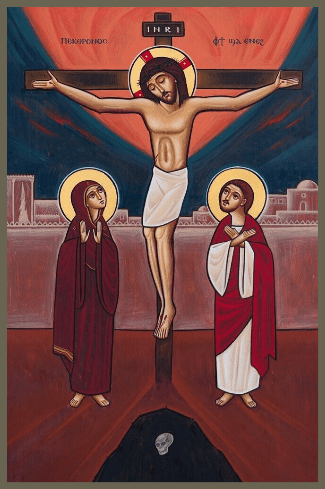
In a biblical context, Jesus redefined Mary’s motherhood while on the Cross. Rather than severing his bond with her, he enriched her maternal role within the framework of salvation. Notably, Jesus entrusted Mary to the Disciple at this pivotal moment in salvation history, underscoring the importance of her role. The redefinition of Mary’s motherhood at the Cross is rooted in her deep connection to her Son and his mission of redemption, as highlighted in Luke 2:34-35. By sharing in her Son’s suffering, Mary is likened to a woman in labor, contributing to the spiritual rebirth of humanity and offering grace to all descendants of Eve (Jer 4:31; Isa 60:20-21; Rev 12:1-5, 17).
In Christian theology, the Evangelist uses the term “the disciple” as a symbolic reference to himself, representing all faithful followers of Christ. This concept is akin to Jacob, who symbolizes Israel and illustrates the idea of a “corporate personality.” * Mary, recognized as the spiritual mother of all disciples, plays a vital role in this framework, having embraced all believers just as the Father has through our participation in divine life through faith, as noted in Ephesians 1:5 and 2 Peter 1:3-4. In the mystery of Christ’s nature, he is the Son of the Father in his divinity and the Son of Mary in his sacred humanity. Therefore, it is understood that one cannot claim to be an adopted son or daughter of the Father while disregarding the relationship with our spiritual mother, Mary, who conceived Jesus by the Holy Spirit. This belief is grounded in the understanding that all faithful individuals are true brothers and sisters of Christ (Rom 8:29).
According to 2 Corinthians 5:17, those who are baptized are transformed into “a new creation in Christ.” This transformation signifies a shift in identity from being descendants of Adam to being part of the lineage of the promised “Woman,” which refers to the mother of the divine Messiah (Gen 3:15). Mary is viewed as an advocate for Eve, who, in her innocence, contributed to the loss of grace for humanity by her actions. This introductory narrative underscores Mary’s importance in salvation history, as early Church Fathers, notably St. Augustine, emphasized her unique role. Augustine of Hippo taught that Mary is exceptional in being both the Mother and the Virgin of Christ, and that her cooperation through faith and charity enabled the spiritual birth of faithful Christians within the Church (De sancta virginitate 6). This belief reflects the early Church’s understanding of Mary’s significance in connection with salvation and grace.
The faithful disciples of Christ are regarded as reborn descendants of Eve, sharing a sanctified connection through Jesus. According to Father Hugo Rahner, baptism is understood as a continuation of the Incarnation, in which God became man through the Virgin Mary, conceived by the Holy Spirit. Rahner emphasizes that the Church, represented as the Mystical Body of Christ, experiences rebirth through the sacrament of Baptism, as indicated in 1 Corinthians 12:13. Mary’s role in the plan of salvation is intricately linked to the mystery of the Church, thereby giving the sacrament of Baptism a distinct Marian character.
Father Hugo Rahner explores the idea that baptism has a distinctly Marian character, thereby clarifying Mary’s role as the Mother of the Church. The author posits that baptism, as a sacrament of initiation into the Christian faith, is deeply connected to Mary’s identity and mission. He emphasizes that Mary’s maternal qualities—her faith, her obedience to God, and her role in the incarnation of Christ—reflect the foundational grace that baptism seeks to impart. Just as Mary gave physical birth to Jesus, baptism symbolizes the spiritual rebirth of believers as children of God.
Rahner also suggests that Mary’s role as Mediatrix further enhances the Marian character of baptism. In the sacrament, believers are incorporated into the life of Christ, mirroring how Mary uniquely brought forth Christ in the world. This mediatorial role means that through Mary, grace and the salvific power of Christ flow to the faithful, thereby reinforcing her position as Mother within the sacramental life of the Church.
Building on the connection between Mary and baptism, Rahner articulates that the Church, like Mary, has a maternal character. The Church nurtures its members, facilitating their growth in faith and helping them to become spiritual offspring of God. This mirrors Mary’s nurturing aspect, in which her acceptance and cooperation with God’s will enabled her to bear Jesus, and also symbolizes the Church’s mission to foster and guide believers in their spiritual journeys. Through baptism, individuals are not only cleansed from sin but also united with the Church’s communal identity.
Father Rahner stresses that this community aspect reflects Mary’s role as the Mother of all Christians. Just as Mary nurtured Jesus and played an essential role in his life and mission, the Church, in turn, takes on this maternal role post-Pentecost, sustaining the baptized through the sacraments and teaching.
Rahner’s insights have broader theological implications for spiritual motherhood. He argues that not only does Mary fulfill this role uniquely, but every baptized believer can aspire to embody a similar nurturing spirit. This invites a deeper understanding of how Christians can foster faith in others, thereby extending the concept of motherhood in faith beyond biological bounds.
Additionally, Father Karl Rahner’s statement that “Mary is Mother of the Church through the Incarnation” reflects his understanding of Mary’s role in the Christian faith, particularly in relation to the Church. When he refers to the Incarnation, he speaks of the moment when Mary conceived Jesus Christ, who is fully divine and fully human. By calling Mary the “Mother of the Church,” Rahner emphasizes her significance not just as the mother of Jesus but also as a spiritual mother to all Christians. He suggests that through her acceptance of God’s will and her unique relationship with Jesus, she embodies the qualities that the Church itself strives for—faith, openness to God’s grace, and nurturing love. *
In this context, Rahner is highlighting that Mary’s role transcends her historical existence; she serves as a model and intercessor for the entire Church. Her motherhood is foundational, as it connects believers to Christ and establishes the Church’s identity as the Body of Christ. Thus, Rahner sees Mary’s maternity as a vital aspect of understanding the nature of the Church and its mission in the world.
Mary is recognized as the Mother of the Church, which encompasses all members of the mystical body of her divine Son, Jesus Christ. She serves as a prototype of the Church, bestowing upon it a unique character that reflects her own significance. In this context, the Church finds its fulfillment through the figure of Mary. Her role in the Church is vividly illustrated by her proclamation: “Be it done to me according to thy word” (Lk. 1:38). This declaration is foundational, as it marks the moment when the Church, represented by Mary, first begins its mission.
The concept extends to the idea that for individuals to be spiritually born into the Church—symbolized by baptism—they must first welcome Jesus into their hearts. This spiritual conception mirrors Mary’s own experience, where she first accepts Christ in her heart before physically conceiving him. Father Hugo emphasizes that Mary embodies the Mother of the Church through the Incarnation. By conceiving and giving birth to Jesus, who is both the Head and the Body of the Church, Mary also spiritually nurtures and brings forth her Son’s brothers and sisters, believers who are incorporated into the Church through faith.
ἔλαβεν ὁ μαθητὴς αὐτὴν εἰς τὰ ἴδια.
In the Gospel of John, the phrase “the Disciple took her to his own” uses the Greek word “lambanō” (λαμβάνω), which means “to take in the hand” or “to grasp.” This term encompasses a range of meanings, including receiving, taking up, or removing without force. In addition to its physical implications, “lambanō” also has mental and spiritual dimensions. It can be interpreted as “making one’s own,” “apprehending,” or “comprehending,” a translation provided by Jerome in the Latin Vulgate. Renowned Roman Catholic Biblical scholar John McHugh expands on this spiritual meaning, suggesting that the Disciple’s action signifies his acceptance of Mary not only as his mother but also as part of the “spiritual legacy” Jesus imparted to him. The use of the verb “lambanō” highlights a significant aspect that goes beyond the immediate context of the death scene at Golgotha, connecting it to deeper spiritual themes.
The author says, “If we carefully notice John’s vocabulary, a more meaningful rendering emerges. In the Fourth Gospel, the verb lambánō has two senses. When applied to material things, it means simply ‘to take hold of,’ ‘to pick up,’ ‘to grasp,’ etc. (e.g. 6.11; 12.13; 13.12; 19.23, 40); when applied to immaterial things, it means “to accept,” or ‘to welcome,’ usually as a gift from God (e.g. his witness, 3.11; his word, 17.8; his Spirit, 14.17; 1 John 2.27). Secondly, the phrase eis ta idea, which certainly can mean “to one’s own home” (in a purely physical sense), can also mean ‘among one’s own spiritual possessions’ (compare John 8.44 and 15.19, in Greek). The phrase is found in the prologue with this double meaning of ‘physical home’ and ‘spiritual possession’ and in close conjunction with the verb ‘to accept or welcome.’ ‘He came to what was his own… and to all who accepted him, he gave them the power to become children of God’ (John 1.12-13). John 19.27 demands a translation that includes the purely physical and the deeper, spiritual sense.” * The use of the verb lambanō indicates something important that moves beyond the death scene being played out on Golgotha but is connected to it. Thus, the verb indicates something which has soteriological and eschatological significance.
The Mother and the Beloved Disciple recognized that a significant event signified a new beginning—one that would continue in both this life and eternally in the Kingdom of Heaven. In examining the original Greek text, the phrase “to the own” (εἰς τὰ ἴδια) offers a deeper meaning than the translations found in modern Protestant and Catholic Bibles, which often render it as “to his own home.” This Greek phrase suggests that the Disciple did not merely take Mary into his physical abode; rather, it indicates a profound spiritual connection in which he embraced her as a loving son within their newly established bond. In this context, the Disciple takes Mary into his heart and accepts her as a spiritual mother, signifying an intimate relationship at the core of his being.
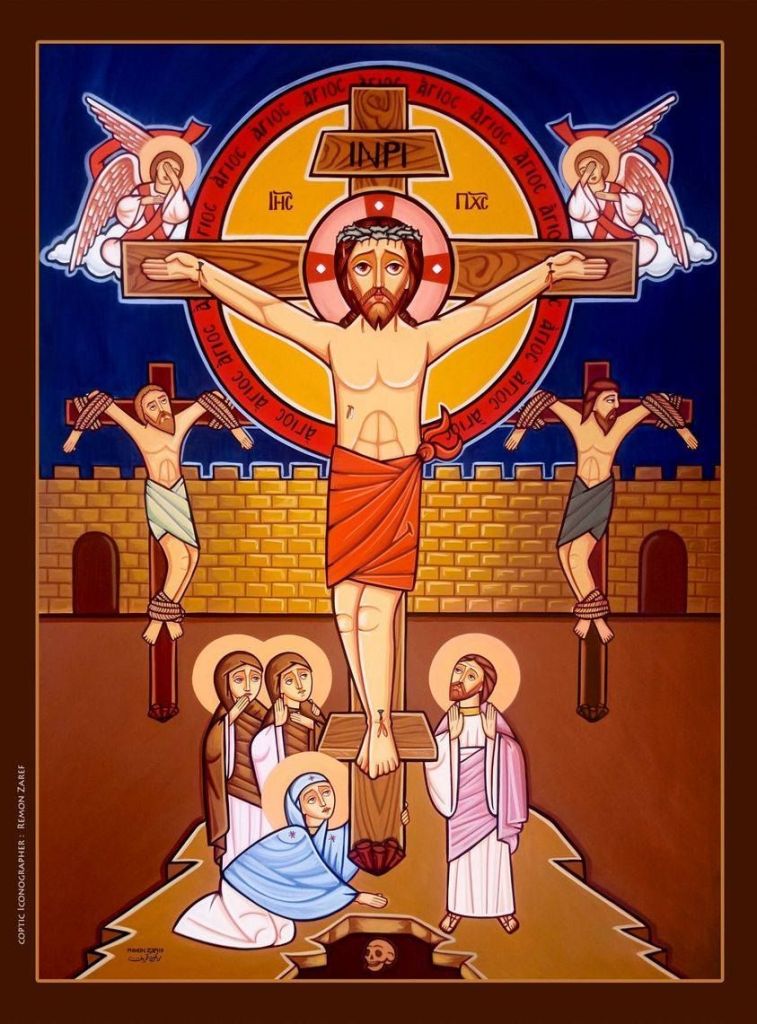
Notably, Jesus refers to his mother, Mary, as “Woman,” a significant association that links her with the concept of the new Eve. This designation suggests that Mary serves as the spiritual mother of all humanity, in contrast to Eve, who is regarded as the primordial mother of all living beings. Unlike Eve, whose offspring are born without sanctifying grace and are spiritually dead (as noted in Genesis 3:20), Mary embodies a figure of grace and life. Additionally, in Genesis 2:23, Adam addresses his wife as “Woman” before the Fall, indicating an original state of innocence and sanctity in their relationship. By using the title “Woman” for Mary, Jesus implies that she is meant to fulfill a maternal role for his disciples, reflecting the intended purpose of Eve before the fall from grace.
Jesus Christ has redeemed humanity from the clutches of death through his sacrifice on the Cross, effectively reconciling the world to God the Father, as highlighted in Colossians 1:20 and 2 Corinthians 5:18-19. This act of salvation not only demonstrates divine love but also fulfills the promise of redemption for all who believe. Mary, the mother of Jesus, holds an indispensable position in this narrative of victory over sin and death. Her role is not merely that of a passive observer; rather, it is at the foot of the Cross where her motherhood of all humanity shines most vividly. There, her heart is pierced, symbolizing her deep suffering as she contemplates the weight of humanity’s sins, fulfilling Simeon’s prophecy that a sword would pierce her soul (Luke 2:35).
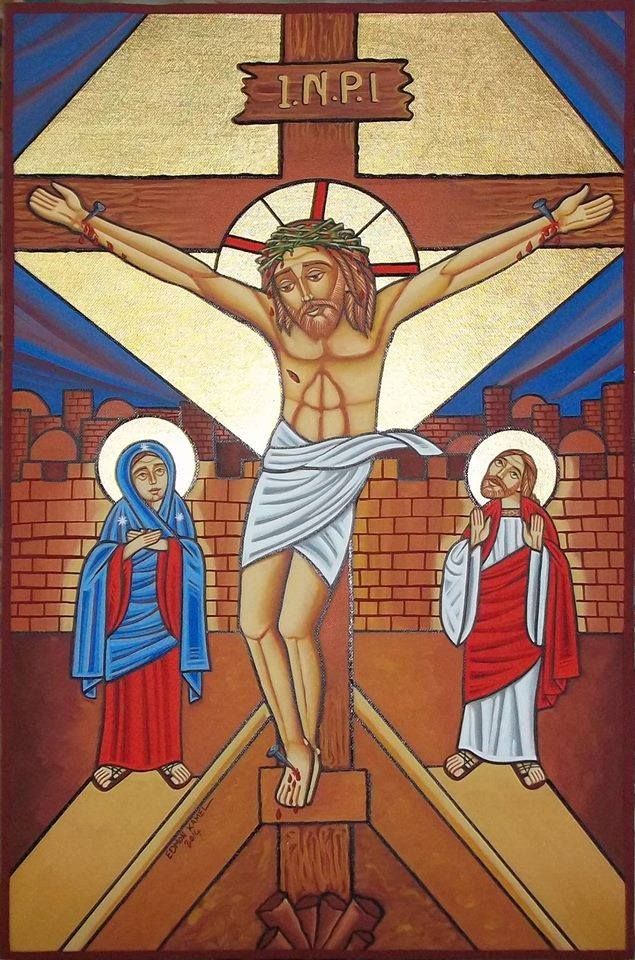
In her unwavering fidelity and union with her divine Son’s infinite sacrifice, Mary offers God a finite yet profound temporal satisfaction for the world’s sins. This union signifies that graces merited by Christ are not just broadly available but primarily dispensed through Mary. As Our Lady of Sorrows, she becomes the channel through which countless blessings flow, reinforcing her vital connection to the mystical Body of Christ and emphasizing her intercessory role in the salvation of souls.
In Luke 1:44, it is noted that John the Baptist, while still in his mother’s womb, leaped in response to Mary greeting Elizabeth. This event is interpreted as a sign of God’s cleansing and healing grace at work, foreshadowing John’s divine mission. In contrast to Eve, who is often portrayed as leading humanity astray by encouraging Adam to eat the forbidden fruit, Mary is seen as playing a pivotal role in restoring grace to humanity. By offering the fruit of her womb, Jesus, she provides the source of restorative grace. This concept is encapsulated in the phrase, “To Jesus through Mary.”

Ave Maria
1 ‘Dogmatic Constitution on the Church, Lumen Gentium, Solemnly Promulgated by His Holiness Pope Paul VI on November 21, 1964, Chapter VIII, The Blessed Virgin Mary, Mother of God in the Mystery of Christ and the Church III. On the Blessed Virgin and the Church’ (60-65).
2 H Wheeler Robinson, Corporate Personality in Ancient Israel (Edinburgh: T&T Clark Publishers, 1993). The original publication date is 1 January 1712. Robinson’s concept of corporate personality in biblical exegesis holds that individuals within the biblical narrative often represent a larger community or group rather than just their personal identity. This approach suggests that an individual’s actions, experiences, and attributes can reflect and embody the collective identity of a nation, tribe, or family. Robinson’s exploration of corporate personality emphasizes the communal aspects of biblical theology, encouraging readers to consider how individual narratives contribute to the larger story of God’s relationship with His people. This approach can lead to richer interpretations in the context of biblical exegesis, emphasizing themes of covenant, corporate identity, and the collective moral responsibilities of communities as depicted in biblical texts.
3 “And on this account, that one female, not only in the Spirit, but also in the flesh, is both a mother and a virgin. And a mother indeed in the Spirit, not of our Head, Which is the Saviour Himself, of Whom rather she was born after the Spirit: forasmuch as all, who have believed in Him, among whom is herself also, are rightly called “children of the Bridegroom:” but clearly the mother of His members, which are we: in that she wrought together by charity, that faithful ones should be born in the Church, who are members of That Head: but in the flesh, the mother of the Head Himself. For it behoved that our Head, on account of a notable miracle, should be born after the flesh of a virgin, that He might thereby signify that His members would be born after the Spirit, of the Church a virgin: therefore Mary alone both in Spirit and in flesh is a mother and a virgin: both the mother of Christ, and a virgin of Christ; but the Church, in the Saints who shall possess the kingdom of God, in the Spirit indeed is altogether the mother of Christ, altogether a virgin of Christ: but in the flesh not altogether, but in certain a virgin of Christ, in certain a mother, but not of Christ. Forsooth, both faithful women who are married, and virgins dedicated to God, by holy manners, and charity out of a pure heart, and good conscience, and faith unfeigned, because they do the will of the Father, are, after a spiritual sense, mothers of Christ. But they who in married life give birth to (children) after the flesh, give birth not to Christ, but to Adam, and therefore run, that their offspring, having been dyed in His Sacraments, may become members of Christ, forasmuch as they know what they have given birth to” [Of Holy Virginity, Chapter 6]. Translated by C. L. Cornish.
In the text, Augustine emphasizes the dual nature of Mary as both a mother and a virgin, highlighting her essential role in Catholic doctrine as the Mother of Christ, who gave birth to Jesus while maintaining her purity. He describes her not only as a physical mother but also as a spiritual mother, nurturing believers through their faith in Christ, whom they see as spiritually connected to her. Additionally, Augustine parallels Mary with the Church, suggesting that while Mary embodies motherhood in both spirit and flesh, the Church also serves as a spiritual mother, giving birth to believers in a non-physical way.
4 Father Hugo Rahner, S.J. Our Lady and the Church (Bethesda: Zaccheus Press, 2010), 63-75. See Chapter Six, Mary at the Font.
5 John F McHugh, The Mother of Jesus in the New Testament (New York: Doubleday, 1975), p. 378.

 Marian Scripture
Leave a comment